Many enterprises have invested in automation, yet scaling it across departments remains a challenge. A finance team may automate invoice processing while customer service continues to handle requests manually. Meanwhile, operations teams spend hours reviewing spreadsheets, checking records, and correcting errors that could be avoided.
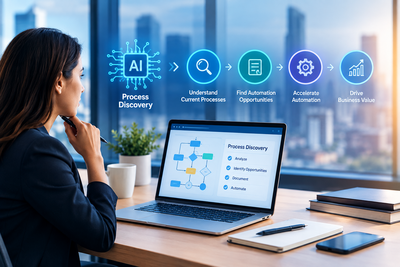
The problem is not always a lack of automation tools. Often, businesses struggle to identify which processes should be automated first and how those processes actually work. This is where Process Discovery becomes valuable. By using AI to analyze business workflows, enterprises can identify automation opportunities, reduce manual analysis, and build a more practical strategy for scaling automation.
Automation often starts with a single department or a specific business requirement. A company might automate invoice approvals or employee onboarding and see promising results. However, replicating that success across the organization is more complicated.
Different departments follow different procedures, use separate applications, and maintain their own documentation. Some workflows depend on spreadsheets, email approvals, and information stored across multiple systems. These variations make it difficult to understand the complete process before introducing automation.
Traditional process analysis can also take considerable time. Business analysts interview employees, document individual steps, and review existing procedures. Although this approach provides useful insights, the findings may not always reflect how employees perform their work every day.
Without accurate process information, organizations risk automating inefficient workflows, overlooking important exceptions, or investing in projects that deliver limited business value.
AI powered Process Discovery helps enterprises understand how work moves through their operations. Instead of relying entirely on interviews and manual documentation, organizations can use process data, workflow records, and other available business information to identify patterns and potential improvements.
Depending on the tools and data sources available, AI can help businesses identify repeated activities, uncover process variations, and highlight tasks that may be suitable for automation.
For example, a financial services company might discover that employees spend several hours each week checking customer information across different applications. Process analysis could reveal which steps are repetitive, where delays occur, and which activities require human judgment.
With these insights, the company can prioritize suitable automation opportunities and direct its resources toward processes with measurable benefits.
AI process discovery can also support automated process documentation, helping teams organize workflow information and reduce the effort required to prepare process descriptions. This gives automation teams a clearer starting point for planning and implementation.
Not every repetitive task deserves immediate automation. Enterprises need to consider transaction volumes, processing time, error rates, business impact, and implementation complexity.
Process Discovery helps teams examine workflows and identify activities that consume significant employee time or create recurring operational problems.
For instance, a manufacturing company may find that purchase order verification involves repeated data entry across several systems. Automating suitable verification steps could reduce administrative effort and help purchasing teams process requests more consistently.
By prioritizing opportunities based on business value and automation readiness, enterprises can avoid spending resources on low impact projects.
Documenting business processes can become a bottleneck when an organization manages hundreds of potential automation projects.
AI driven process discovery can help analysts review workflow information, identify recurring patterns, and prepare initial process documentation more efficiently. Teams can then spend more time validating findings, understanding exceptions, and deciding how a workflow should improve.
Human review remains important, particularly when processes involve regulatory requirements, sensitive information, or complex business decisions. The goal is to reduce repetitive analysis without losing the context that employees bring to process improvement.
Enterprise automation becomes difficult to manage when each department works independently. Teams may develop similar solutions, overlook dependencies, or follow inconsistent standards.
A structured process discovery approach gives decision makers a clearer view of how work moves across departments and where systems or activities intersect.
Consider employee onboarding. Human resources may collect employee information, IT may create user accounts, and finance may configure payroll. If these activities are disconnected, new employees may experience delays.
Mapping the end to end workflow helps identify dependencies and opportunities to coordinate or automate suitable steps. Better visibility also supports governance, standardization, and reuse across automation projects.
Scaling automation requires more than completing individual projects. Enterprises need a repeatable method for evaluating processes, assessing feasibility, measuring results, and selecting the next opportunities.
Process Discovery can support this approach by helping organizations maintain a clearer understanding of their workflows and improvement priorities.
Businesses can establish a common evaluation framework that considers expected savings, process stability, system compatibility, compliance requirements, and operational risk. They can then track outcomes such as reduced processing time, fewer errors, and lower manual effort.
This creates a stronger foundation for automation lifecycle management and helps leadership make decisions based on business results rather than assumptions.
Before selecting a solution, organizations should evaluate their existing systems, data availability, security requirements, and business objectives.
A suitable AI process discovery platform should provide useful workflow insights, support relevant data sources, and help teams identify actionable improvement opportunities. Integration capabilities matter because enterprise processes rarely operate within a single application.
Organizations should also consider data privacy, access controls, and the reliability of generated findings. AI can accelerate analysis, but business teams must validate recommendations before making significant operational changes.
Start with a defined business problem, such as reducing invoice processing delays or improving customer onboarding. Measure the current performance, assess the discovered opportunities, and compare the results after making improvements. This approach makes it easier to demonstrate value before expanding the initiative.
Scaling automation faster starts with understanding how work actually gets done. AI powered Process Discovery helps enterprises identify bottlenecks, prioritize valuable opportunities, and reduce the time spent analyzing business workflows.
When combined with clear governance, employee expertise, and measurable business goals, it can help organizations move beyond isolated automation projects toward a coordinated enterprise strategy.
The real advantage is not simply automating more tasks. It is making better decisions about what to automate, why it matters, and how each improvement contributes to long term business performance.